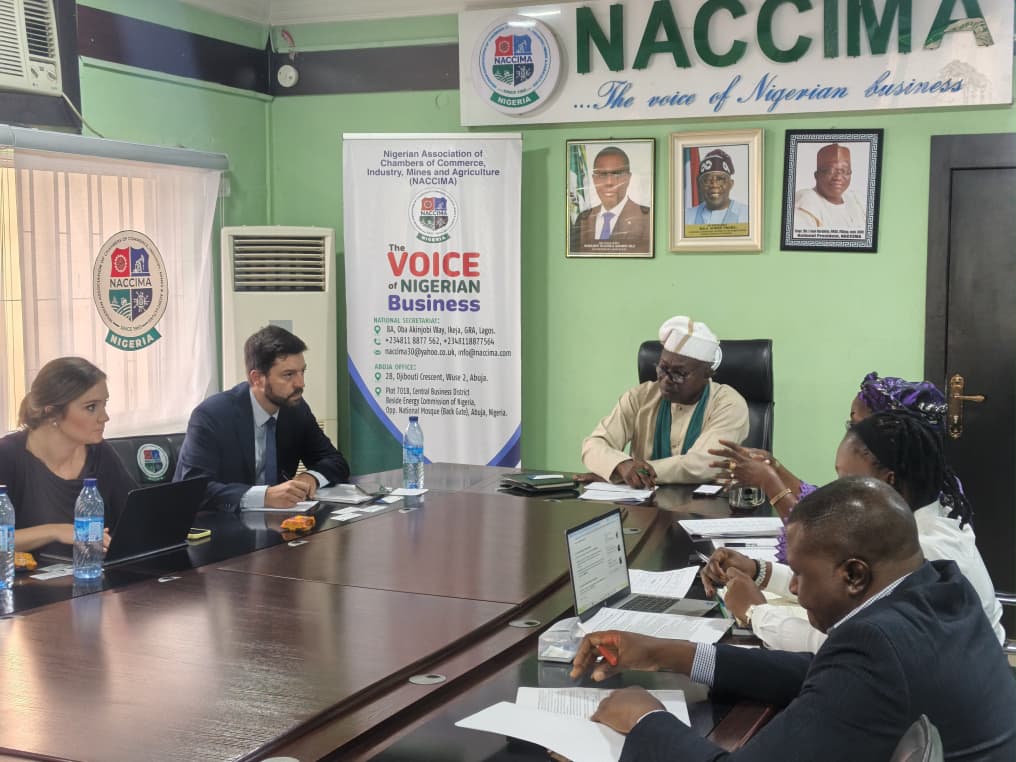
The Nigerian Association of Chambers of Commerce, Industry, Mines and Agriculture (NACCIMA) has held a strategic engagement with a delegation from the Organisation for Economic Co-operation and Development (OECD) to discuss opportunities for strengthening Nigeria’s business environment, investment facilitation, SME development and private-sector participation in ongoing economic reforms.
The OECD delegation was received on behalf of the NACCIMA National President, Engr. Jani Ibrahim, mni, OON, by Alhaji Yahaya Idris Oladiran, National Vice President, NACCIMA.
The engagement provided an opportunity for both organisations to exchange perspectives on some of the major challenges affecting businesses in Nigeria and to identify areas where stronger institutional collaboration could support private-sector growth and competitiveness.
Discussions focused on a range of issues affecting enterprises across the country, including regulatory overlaps, business registration and licensing requirements, labour rights, child labour, insecurity and corruption.
NACCIMA highlighted the burden created by multiple and sometimes overlapping regulatory and compliance requirements and called for simpler, more coordinated and business-friendly processes across relevant authorities.
Particular attention was drawn to the need for improved coordination among the Corporate Affairs Commission (CAC), Federal Inland Revenue Service (FIRS), state governments and local government authorities, especially in relation to business registration, taxation, licensing and compliance.
NACCIMA noted that greater regulatory clarity and coordination would help reduce the cost of doing business, improve formalisation and create a more predictable operating environment for enterprises.
The Association also presented some of its initiatives aimed at strengthening the capacity and competitiveness of Nigerian businesses, particularly SMEs and young people.
These include programmes implemented through the NACCIMA Foundation and the NACCIMA Technical and Vocational Education and Training (TVET) Programme, which are focused on skills development, enterprise support and improving opportunities for young Nigerians.
NACCIMA emphasised that effective SME development requires a combination of interventions, including capacity building, access-to-finance linkages, market access, digitalisation, export development and integration into domestic and international value chains.
The Association stressed that improving these areas would enable more Nigerian enterprises to scale, compete effectively and contribute more significantly to employment creation and economic growth.
The meeting further underscored the importance of stronger collaboration among NACCIMA, government agencies, financial institutions, investors and development partners in improving Nigeria’s investment climate.
Particular emphasis was placed on strengthening engagement with the Nigerian Investment Promotion Commission (NIPC) and the Presidential Enabling Business Environment Council (PEBEC).
Such collaboration, NACCIMA noted, can support investment facilitation, regulatory reform, investor linkages, policy feedback and sustained advocacy for improvements in the business environment.
The Association also stressed the importance of ensuring that the experiences and priorities of businesses are adequately reflected in the design and implementation of economic reforms.
The meeting produced a number of areas for continued cooperation between NACCIMA and the OECD:
The engagement reaffirmed the importance of stronger institutional coordination in building a more predictable, competitive and investment-friendly business environment in Nigeria.
NACCIMA also reiterated its commitment to promoting responsible business practices, labour rights, anti-corruption measures, the prevention of child labour and inclusive private-sector-led economic growth.
Through continued engagement with international development partners, government institutions and the organised private sector, NACCIMA remains committed to advancing policies and initiatives that strengthen Nigerian enterprises and support sustainable economic development.

